They say water is life. While safe and clean water is often taken for granted, remote communities such as Daudi Village in Mangochi District remain on the margins. In this story, Correpondent STEVE GOVATI reflects on Daudi villagers’ daily struggle.
For the people of Daudi Village, the search for water is exhausting and hazardous.
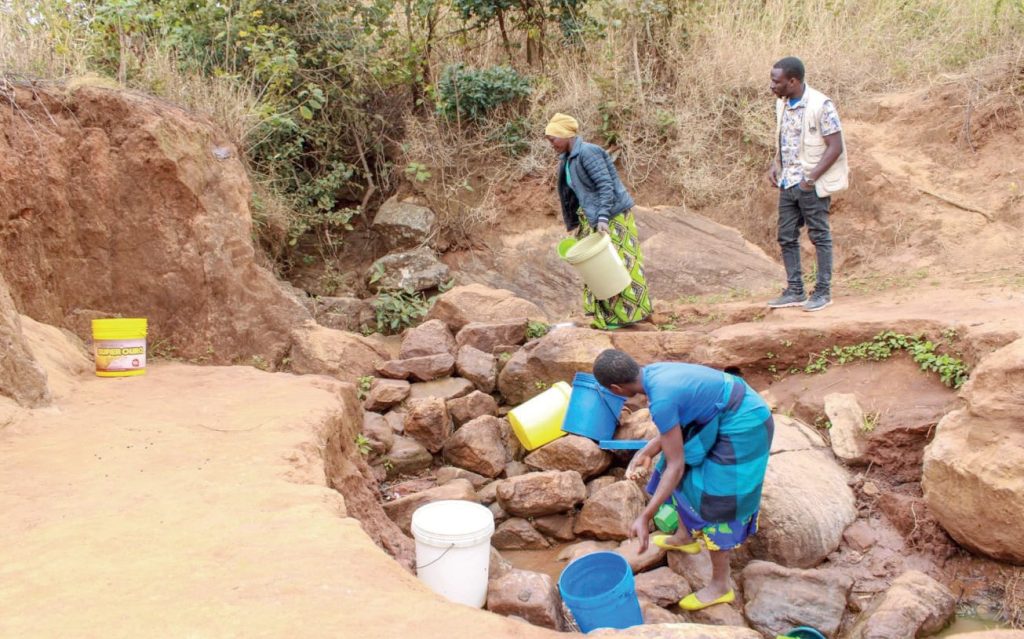
The community relies on a meandering river that split a vast valley, a 10-minute walk from their homes.
Annie Ali, 46 is one of the villagers whose resilience belies the harsh reality she faces every day.
“We use water from the river for cooking, drinking, cleaning, bathing, everything,” Ali explains, pausing with a weary sigh. “The water is so salty and often undrinkable. In the dry month, when the borehole at the nearby school dries up, the river is our only option.”
Even the overwhelmed borehole at the school, meant to be lifeline for learners, teachers and surrounding communities, frequently dries up when the dry season kicks in.
“Long queues under the scorching sun are draining. We wait for hours just to fetch water and the queue leaves us with no time to go and find food for ourselves,” Ali laments.
From August to September, when summer is at its peak, boreholes dry out and the villagers’ only hope is the muddy water from the nearby river. Few families can afford or access chemicals for treating the murky water.
During the visit to Mangochi, the author walked with Ali to the river to get a glimpse of unsafe water sources that put the community at risk of sanitation-related diseases blamed for over half of the outpatients in the country’s healthcare facilities.
A small spring trickled through the dry riverbed, barely flowing. Nearby, someone scrubbed dishes in muddy water, evidence of necessity overriding sanitation. Wild animals and livestock drink from the same well.
“It’s unhealthy to do everything so close to the water, but what choice do we have?” said Ali.
The strain is relentless. Yet, amidst the hardship, a glimmer of change is beginning to show.
Islamic Relief is implementing a two-year initiative to provide clean water, education and health services to underserved villages in Mangochi, Balaka, Chiradzulu and Phalombe.
The news excites Ali. Her face lights up, a shift from despair to cautious optimism.
“I’ll be praying for the success of this mission. Thank you for giving us hope and safe water,” she says.
Unicef estimates that 67 percent of Malawi’s households have access to drinking water, but the proportion of those who cannot find safe water within their localities is higher in rural areas.
The figures show that improved drinking water sources are more common in urban areas at 87 percent compared to 63 percent in rural areas like Daudi.
Only 77 percent of water points nationwide are functional. The rest no longer work because of old age, neglect, lack of spare parts and inadequate community-based water management structures.
The uneven distribution has given to a policy shift that requires government and its partners to switch to piped water systems for accelerated rural water supply after decades of overdependence on boreholes fitted with hand pumps.
In Daudi village, the water may still trickle slowly, but hope is finally beginning to flow.
With support from multiple partners, Islamic Relief continues to provide access to clean water in areas where it works.
Islamic Relief is dedicated to easing the suffering of people around the world.
For the past five years, the charity has constructed and rehabilitated over 25 water facilities in the four districts.